


Trip Finder
Jomolhari Trek with a Culture Tour of Paro and Thimphu, 12 Days
Days: 12 /
Difficulty: 3 of 5 (Moderate to strenuous)
Min Group Size: 1 /
Max Group Size: 4
Jomolhari Trek with a Culture Tour of Paro and Thimphu
Beginning from Paro valley, your trek starts with gentle ascent through Bhutan’s undisturbed forest of rhododendrons and pines. Passing through the villages with lush fields of rice, wheat, barley and crossing over the tree lines you arrive in the regions sparsely inhabited by the migrant yak herders. The trail continues through enchanting valley flanked with snowcapped peaks to the base of Mount Chomolhari and its spike shaped companion, Jichu Drake.
You spend one entire day exploring the vicinity or just relaxing and enjoying the wonders of nature. You resume your trek to the Thimphu valley by crossing two major passes through the remote wilderness with abundant of wildlife, including, blue sheep, Takin and variety of birds, perhaps under the surveillance of the elusive snow leopard. There will be ample of opportunities to interact with the friendly people of Bhutan and learn their philosophy of “GROSS NATIONAL HAPINESS”. After the trek, you have a day to see Bhutan’s tiny Capital city with no traffic light.
Facts of the Trip
Similar Trips
Bhutan Cultural Tour With Druk Path Trek, 9 Days
from USD 2,600 / Days: 9 / Difficulty: 2 of 5 (Moderate)
Bhutan Cultural Tour With Soi Yaksa Trek, 11 Days
from USD 3,200 / Days: 11 / Difficulty: 2 of 5 (Moderate)
Snowman Trek (Extreme), 30 Days
Days: 30 / Difficulty: 5 of 5 (Very Strenuous)
Tsaluna Trek, 8 Days
Days: 8 / Difficulty: 2 of 5 (Moderate)
Perfect Bhutan Tour - 6 Nights/ 7 Days
from USD 1,620 / Days: 7 / Difficulty: 1 of 5 (Easy)
Cultural Tour In Bhutan In The Land Of The Dragon, 13 Days
Days: 13 / Difficulty: 2 of 5 (Moderate)
Cultural Tour Of West And Central Bhutan, 10 Days
Days: 10 / Difficulty: 2 of 5 (Moderate)
Itinerary for Jomolhari Trek with sightseeing Tour in Paro and Thimphu
Day 1: Arrive at Paro International Airport and transfer to hotel
Paro is situated in a beautiful valley at 2280 metres and is a fitting introduction to this charming kingdom. Your guide will meet you and take you to your hotel. There should be time for a quick stroll around Paro town before lunch. In the afternoon you can visit the impressive Paro Rinpung Dzong, one of the finest examples of Bhutanese architecture. You can also visit the National Museum. This was previously housed in the Ta Dzong (watch tower) built on top of the hill above Rinpung Dzong to defend Rinpung Dzong and the Paro valley during times of war, in an unusual circular construction resembling a conch shell. Unfortunately, an earthquake in September 2011 damaged the Ta Dzong and the contents of the museum were moved to a neighbouring building. You can still see a magnificent collection of Bhutanese artefacts — costumes, religious paintings, arms, textiles and a fascinating collection of Bhutan stamps. The National Museum is due to reopen in the Ta Dzong in 2015. Overnight at a 3-star hotel in Paro.
Day 2: Take a day walk to the ‘Tiger's Nest’
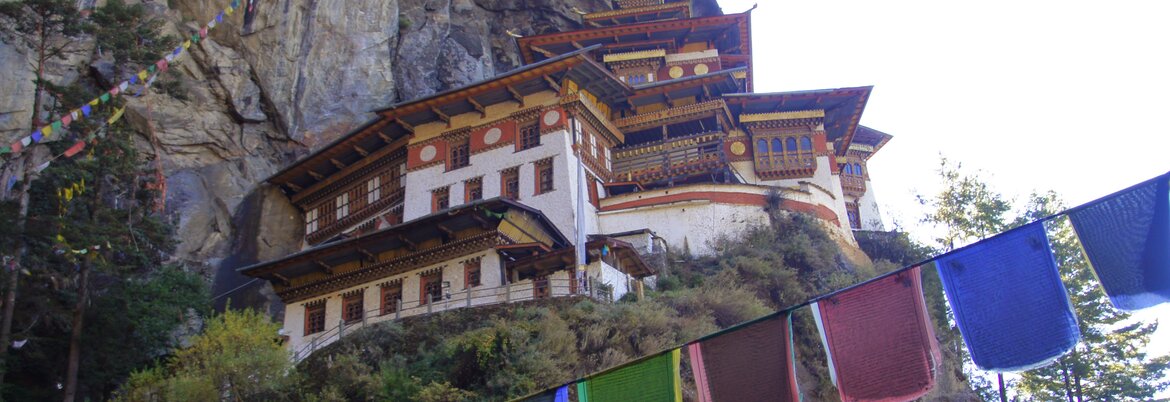
‘Tiger's Nest’, is the sacred Taktshang monastery which clings to the rock face 900 metres above the valley floor. Guru Rinpoche is said to have flown to the site riding on a tigress. He subsequently meditated here for three months. It is one of Bhutan’s most holy sites and draws pilgrims not only from Bhutan but also from neighboring Buddhist countries. You can have lunch at the Taktshang cafeteria from where you get a spectacular view of the monastery. In the afternoon you can also visit the 7th century Kyichu Lhakhang, a temple of historical significance and one of the most sacred shrines in Bhutan. Overnight at a 3-star in Paro.
Day 3: Paro to Shana 2870m/15km/5-6 hours (Jomolhari Trek - Day 1)
Drive to the end of the motor road at Drukgyel Dzong to begin the trek. While you wait for the horses to load up you will have time to take a look at the ruined Dzong. Known as the fortress of victory, it was constructed to commemorate the victory over Tibetan invaders in 1644 and destroyed by a butter lamp fire in 1951. Today’s trail follows the river uphill through a narrow agricultural valley as far as the border army camp at about 2800m. There is now a feeder road as far as the army check post at Gunitsawa about half an hour before camp. Overnight at a tented camp in Shana.
Day 4: Shana to Soi Thangkha 3750m/20km/8-9 hours (Jomolhari Trek - Day 2)
The path from Shana ascends through the river valley with pine and rhododendron forests. On the way, there is a fantastic view of Mount Jomolhari. We will camp in a meadow with a stone shelter at an altitude of about 3750m. Overnight at a tented camp in Soi Thangkha.
Day 5: Soi Thangkha to Jangothang 4040m/17km/5-6 hours (Jomolhari Trek - Day 3)
The trail continues to follow the river and passes a small army post where the valley begins to widen again. Views of high ridges and snow-capped peaks can be seen on all sides. At this altitude (about 4040m) it is possible to see yaks and yak herders. Camp is beneath a ruined fortress at the base of Mount Jomolhari. Overnight at a tented camp in Jangothang.
Day 6: Rest day at Jomolhari base camp (Jomolhari Trek - Day 4)
An opportunity to explore the glacier, do some washing in the stream (icy cold!) or just take it easy. If you feel like going further afield the guide will discuss the options with you. Overnight at a tented camp in Jomolhari Base Camp.
Day 7: Jangothang to Lingshi 4010m/18km/6-7 hours (Jomolhari Trek - Day 5)
The trail climbs gradually and then more steeply to Nyeli La (4850 m). On the way you will be rewarded when you stop for breath with tremendous views toward Jomolhari and Jitchu Drake. If the weather is clear, Lingshi Dzong can be clearly seen as we descend into the Lingshi basin, and Tserim Kang with its glaciers can be seen to the north. Follow the ridge for a long way until you drop through the forests to our camp just outside Lingshi village beside a stone shelter at 4010 metres. Overnight at a tented camp in Lingshi.
Day 8: Lingshi to Shodu 4100m/19km/7-8 hours (Jomolhari Trek - Day 6)
Today’s walk is tough. The trail ascends to the Yali La Pass (4820 m), the highest point of the trek, from where Mount Jomolhari, Tserim Gang and Masa Gang can be seen on a clear day. After the pass it is a long descent to the campsite which is situated at about 4100m. Overnight at a tented camp in Shodu.
Day 9: Shodu to Barshong 3600m/16km/5-6 hours (Jomolhari Trek - Day 7)
The path follows the Thimphu Chu (river) through forests of rhododendrons, juniper and pine. The view of the cliff facing rocks and water falls are stunning. The trail gradually ascends after 3 or 4 hours to the ruins of Barshong Dzong. The camp is a stone shelter just below the ruined fortress. Overnight at a tented camp in Barshong.
Day 10: Barshong to Dodena 2600m/17km/5-6 hours (Jomolhari Trek - Day 8) and drive to Thimphu
We continue to follow the Thimphu Chu through dense rhododendron forest before emerging into pastureland. We climb to a mountain meadow at about 3428 m and over a small pass. A vehicle will be waiting to collect us at Dodena for the drive to Thimphu. Overnight at a 3-star hotel in Thimphu.
Day 11: Thimphu sightseeing tour
We will visit the weekly market, the revered Memorial Chorten, the National Library and the School of Traditional Arts. You could visit Changangkha temple, perched on the hilltop overlooking the town. Devotees flock throughout the day to circumambulate and turn the prayer wheels. The temple also contains beautiful wall paintings and hundreds of religious scriptures written in gold. In the afternoon you can take in more of the sights and culture of the capital, with the option of a trip to Simtokha Dzong (one of the oldest fortresses in Bhutan, dating from 1629 AD). If you prefer to stay closer to town you could drive up to the Radio Tower (offering splendid views of the city from a hilltop festooned with prayer flags), visit the Takin Reserve showcasing the unique national animal, the Takin, browse the striking collection of intricate textiles at the National Textile Museum or visit the Folk Heritage Museum. If you would like to view or buy Bhutanese handicrafts you may like to visit the new market opposite Taj Tashi hotel which has an array of stalls run by local handicraft shops selling purely home made articles with no imports. Tell your guide what takes your interest. In the evening take the short drive to Paro. Overnight at a 3-star hotel in Paro.
Day 12: Fly from Paro to your further destination
Early in the morning your guide will accompany you to the airport to see you off onto your flight and wish you Tashi Delek (goodbye and good luck).
# Bhutan Trip Package Cost (3-Star Hotel):
01Pax - USD Per Person
02Pax - USD 3520 Per Person
03Pax - USD Per Person
04Pax - USD Per Person
Additional Cost for Single Room Supplement; USD Per Person
# Bhutan Trip Package Cost (4-Star Hotel):
01Pax - USD Per Person
02Pax - USD 3630 Per Person
03Pax - USD Per Person
04Pax - USD Per Person
Additional Cost for Single Room Supplement; USD Per Person
Note: Both way flight ticket cost from Kathmandu-Paro-Kathmandu is USD 525-USD 550 Per Person.
Customize Your Trek and Tour in Bhutan: This is a general itinerary, which can always individually be “tailormade”. The trek package can be redesigned or redeveloped as per your taste, For more information please e-mail us at snftnepal@gmail.com or snftnepal@yahoo.de
Note: In case of emergency during the trip, Helicopter will be arranged by Swiss Himalayan Family Treks and Expedition Pvt. Ltd. The charges must be paid by the clients themselves.
| Dates | Pricing | Status * |
|---|---|---|
| Flexible / On request Book this Trip | Adult: USD 3,520 EUR 3.100 SFr 2.857 GBP 2.672 AUD 5.122 CAD 5.008 | Available on request |
* Dates can be flexible, please contact us for individual dates.
Our Bhutan Tour and Trek Package Cost includes:
* Airport/Hotel/Airport pick up and transfer by private car/van.
* Sightseeing - all sightseeing and entrance fees including any festival visits in Bhutan.
* Transport - meet on arrival, airport transfers on arrival and departure and all overland transport within Bhutan.
* Accommodation - deluxe accommodation in single/double/twin bed sharing basis at a 3-star/4-star hotel in Paro and Thumphu and tented camp accommodation throughout the trekking in Bhutan.
* Food - full board (breakfast, lunch and dinner) throughout the trip in Bhutan.
* Camping Equipment - member tents, kitchen tent, dinning tent, toilet tent, mattresses and kitchen utensils.
* 1 experienced, helpful and friendly English speaking Bhutanese local guide, 1 cook and necessary porters/donkeys during the trek, their food & accommodation, salary, equipment & insurance.
* Bhutan Visa Fee and Daily Government Royalties.
* First Aid Medical Kit.
* Agency Service charge.
Our Bhutan Tour and Trek Package Cost doesn't include:
* Travel insurance.
* International air fare to and from Nepal and to and from Bhutan.
* Pony/Horse renting for Tiger Nest Monastery hike.
* Bhutanese Traditional Hot Stone Bath and Archery.
* Items and expenses of personal nature.
* Any kind of alcoholic drinks, cold drinks, laundry, phone call, Internet, Hot Shower.
* Personal Trekking Equipment.
* Emergency Evacuation (Helicopter Rescue).
* Any costs which arise due to a change of the itinerary, because of landslides, political disturbance, and strikes etc.
* Any other costs whatsoever, that is not mentioned in the cost included.
* Tips for guide, porters, driver...
Tipping is expected but it is not mandatory.